What Is Human-Centered Design (HCD)? Meaning, Process, and Examples

Mathew Sebastian
Founding Board Member, HCD Institute
Quick answer: HCD stands for Human-Centred Design (spelt Human-Centered Design in American English) — a problem-solving approach in which the needs, behaviours, and aspirations of real people drive every design decision, from how a challenge is framed to how success is measured. The process typically moves through four looping phases: Immerse, Frame, Create, and Deliver. This guide is the most complete introduction to HCD written for an Indian audience: its meaning, its history, the full process, sector-by-sector examples across government, healthcare, education, and business, its relationship with artificial intelligence, and how to start practising it today.
The 4 Steps of the Human-Centred Design Process at a Glance
Immerse (research): observe and listen to real people in their own context.
Frame (synthesis): turn what you saw into insight and define the right problem.
Create (ideation and prototyping): generate many ideas and build cheap prototypes.
Deliver (testing and scaling): test with real users, refine, launch and measure whether lives improve.
The steps loop rather than run in a straight line. They map onto the Design Council's Double Diamond (Discover, Define, Develop, Deliver) and the ISO 9241-210 cycle, both explained below.

Every product, service, or policy that fails does so for the same underlying reason: somewhere along the way, the people it was meant to serve stopped being the point. Human-centred design — commonly abbreviated as HCD — is the discipline of making sure that never happens: a way of solving problems that begins with people, stays with people, and is judged by whether people's lives actually improve.

At HCD Institute, we have taught and practised HCD since 2011, when the institute was founded under the mentorship of the late Prof. M P Ranjan of the National Institute of Design. Our conviction then, as now: design thinking should not be locked inside design schools. It belongs in classrooms, panchayats, hospitals, factories, and boardrooms.
HCD Meaning: Defining Human-Centred Design
HCD full form: Human-Centred Design (in American English, Human-Centered Design). It is a problem-solving approach in which the needs, behaviours, and aspirations of real people drive every decision — from how a challenge is framed, to which ideas are pursued, to how success is measured.
The international standard ISO 9241-210 defines human-centred design as an approach that aims to make systems usable and useful by focusing on users, their needs and requirements, and by applying human-factors, ergonomics, and usability knowledge. The same standard sets out principles that still hold today: the design is based on an explicit understanding of users, tasks, and environments; users are involved throughout design and development; the design is driven and refined by user-centred evaluation; the process is iterative; the design addresses the whole user experience; and the team includes multidisciplinary skills and perspectives. Those principles now underpin national service standards from the UK's GOV.UK to the NHS.
Two words in that definition carry the weight:

Real — not the imagined customer in a strategy deck, but the actual farmer, nurse, student, or commuter, observed in their own context.
Every — people are not consulted once at the start and once at the end. They are participants throughout. The shift is from designing for people to designing with them.
HCD vs Design Thinking: What's the Difference?
The two terms travel together, and they are related but not identical.
Human-centred design (HCD) is the philosophy — the commitment to putting people at the centre of problem-solving.
Design thinking is a methodology — one structured, repeatable process for acting on that philosophy, typically moving through cycles of research, definition, ideation, prototyping, and testing.
A useful analogy: HCD is the compass; design thinking is one of the maps. You can practise human-centred design through service design, participatory design, systems design, or frugal innovation — design thinking is simply the most widely taught route in. If you want the practical distinction spelt out, our companion piece argues that design thinking is not a one-off workshop but a durable organisational capability.
A Brief History of Human-Centred Design — Global and Indian
The global story usually begins with ergonomics and human-factors engineering in the 1940s, when wartime engineers realised that cockpits and control panels had to be built around human perception and error, not the other way round. The now-famous insight was that there is no such thing as "pilot error" when a badly designed switch invites the mistake — the design is at fault. Through the second half of the twentieth century, this thinking spread from hardware to software, from usability to experience, and eventually from products to services, systems, and policy.
A few milestones anchor the timeline. In the 1980s the cognitive scientist Don Norman popularised the term "user-centered design" and, with his book The Design of Everyday Things, taught a generation that confusing doors and unusable controls were design failures, not user failures. In 1991 the firm IDEO was formed in California and turned human-centred design into a mainstream business practice, later releasing open HCD toolkits used around the world. In 2004 Stanford's d.school (the Hasso Plattner Institute of Design), co-founded by David Kelley, codified the five-stage design-thinking process — empathise, define, ideate, prototype, test — that most people learn first. And in 2010 the International Organization for Standardization published ISO 9241-210, giving human-centred design a formal, auditable definition.
India has its own HCD lineage, and it is older than most people realise. The India Report of 1958, written by Charles and Ray Eames at the invitation of the Government of India, argued that design in a newly independent nation must serve the everyday needs of ordinary citizens — and led directly to the founding of the National Institute of Design in Ahmedabad in 1961. NID's tradition of fieldwork-led, socially rooted design — carried forward by educators like Prof. M P Ranjan, whose work on bamboo craft, rural livelihoods, and design for development shaped generations of practitioners — is human-centred design by another name, practised decades before the term became fashionable. The parallel matters: while the West arrived at HCD through usability and industrial design, India arrived through development, craft, and the sheer discipline of designing under constraint.
HCD Institute stands in this lineage. Our curriculum, formally adopted by Mahatma Gandhi University's Senate, exists to democratise these methods beyond the small circle of trained designers.
The Human-Centred Design Process: 4 Phases
Most HCD work moves through four broad movements. In practice they loop and overlap rather than proceed in a straight line — findings in the third phase routinely send you back to the first. Globally the same journey is often drawn as the "Double Diamond": a first diamond that diverges to explore the problem and converges to define it, and a second that diverges to develop solutions and converges to deliver one. Whichever map you use, the rhythm is identical — open up to understand, narrow down to decide.
1. Immerse
Go to where the problem lives. Observe people in their real environment. Listen more than you ask. The aim is not data collection but understanding — noticing the workarounds, frustrations, and unspoken needs that surveys never capture. A designer immersing in a rural clinic learns more from watching a grandmother navigate the queue than from any patient-satisfaction form. Tools at this stage include contextual interviews, shadowing, journey mapping, and simply spending unhurried time in the field.
2. Frame
Convert observations into insight, and insight into a well-defined challenge. This is where most projects are won or lost: solving the right problem matters more than solving a problem right. A hospital that frames its challenge as "reduce waiting time" will design differently from one that frames it as "reduce the anxiety of waiting." Good framing is written from the point of view of the person experiencing the problem, and it is narrow enough to act on yet open enough to invite many solutions.
3. Create
Generate many possibilities before committing to one. Build rough, cheap prototypes — a paper sketch, a role-play, a cardboard model — and put them in front of real people early. The prototype's job is to be wrong quickly and cheaply, so the final solution can be right. A prototype is not a smaller version of the finished thing; it is a question made tangible, designed to earn a specific piece of feedback.
4. Deliver
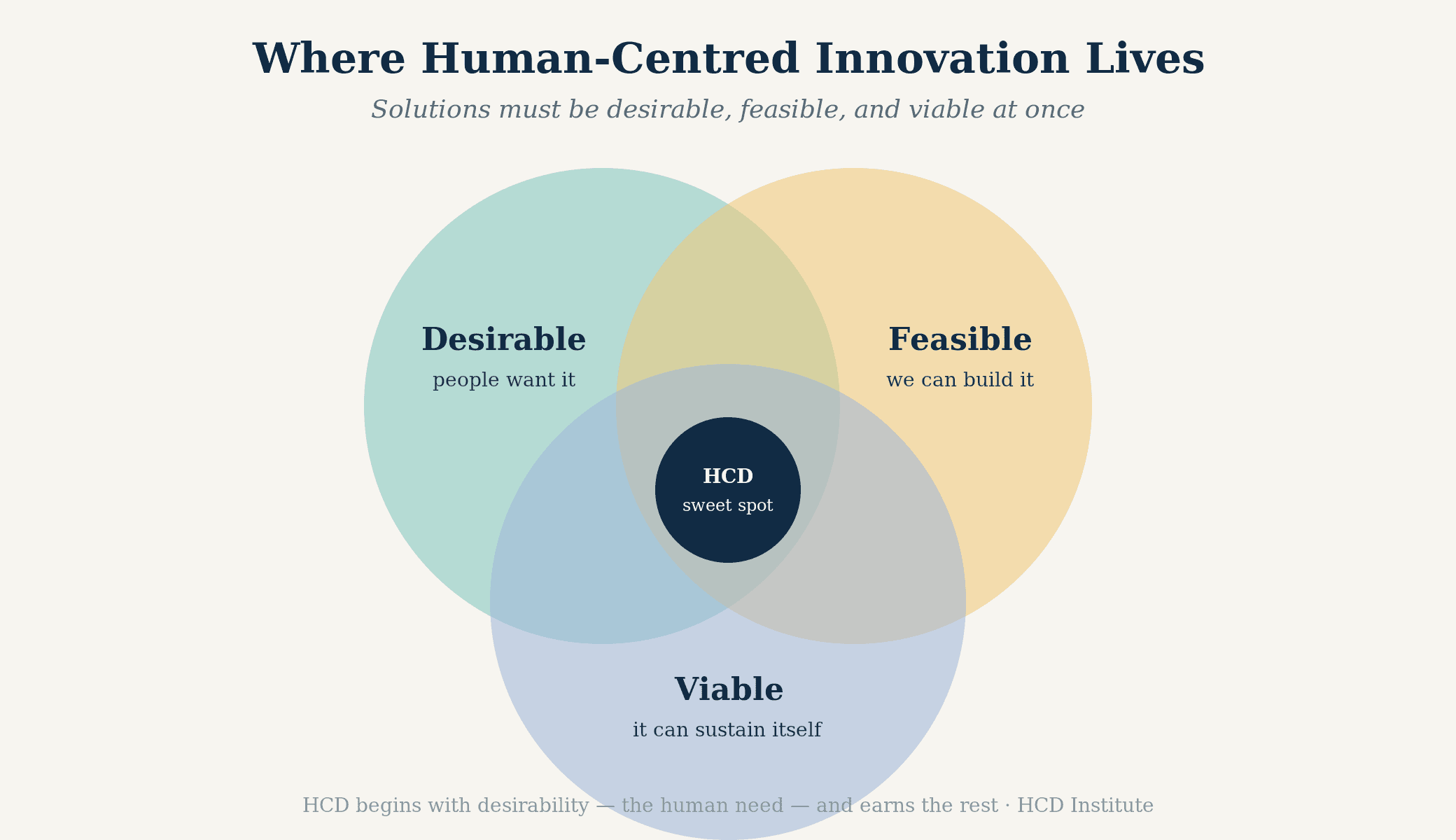
Refine what works, plan for viability and scale, and keep measuring against the only standard that matters: are people's lives genuinely better? Delivery is also where the other two lenses of good design join desirability: a solution must be not only desirable (people want it) but also feasible (it can be built) and viable (it can sustain itself). Human-centred design begins with the human need and then earns its way to feasibility and viability — never the reverse.
HCD Mindsets: The Thinking Behind the Method
Steps can be copied; mindsets have to be cultivated. In our teaching at HCD Institute, we return again and again to six:
Empathy. The disciplined effort to understand another person's experience from the inside — their constraints, motivations, and context — and to let that understanding override your assumptions.
Beginner's mind. The willingness to approach a familiar problem as if seeing it for the first time. Expertise is valuable; certainty is dangerous.
Comfort with ambiguity. Meaningful problems are messy in the middle. Rushing to a solution to escape discomfort usually means solving the wrong problem elegantly.
Bias to action. An hour of prototyping teaches more than a week of debate. Make something, show someone, learn.
Radical collaboration. The best insight in the room rarely belongs to the most senior person in it. Diverse teams — across disciplines, hierarchies, and lived experience — see what homogeneous teams cannot.
Systems awareness. No solution exists in isolation. A new service touches livelihoods, habits, ecosystems, and institutions. Designing for people means designing for the systems people live inside.
Human-Centred Design Across Four Sectors in India
The clearest way to understand HCD is to watch it work. India offers unusually rich examples because it forces designers to serve enormous diversity under real constraint — and because, again and again, solutions built here for scarcity have gone on to be studied by the rest of the world. We collect ten of them in our companion article, 10 Human-Centered Design Examples from India; below, four sectors in depth.
1. Government and Public Services
Public services are where human-centred design has the highest stakes and the widest reach. India's Digital Public Infrastructure (DPI) — the "India Stack" of Aadhaar, UPI, DigiLocker, and consent-based data systems — now serves more than a billion people, and its success rests on relentless attention to how ordinary citizens actually behave.
UPI is the standout. It transformed digital payments not by importing card-based models built for other economies, but by designing for the real Indian user: many banks, low-cost phones, patchy connectivity, zero tolerance for transaction fees, and trust built through radical simplicity. The result is a system now processing well over ten billion transactions a month and copied by other nations. We unpack how it was built in UPI: Human-Centred Design at Scale.
Aadhaar and DigiLocker reframed identity and paperwork around the citizen rather than the department, letting a migrant worker prove who they are or produce a document from a basic phone. eSanjeevani, the national telemedicine platform, and CoWIN, the vaccination backbone during the pandemic, show the same instinct — meet people where they are. The lesson public administrators keep re-learning, sometimes expensively, is that adoption is a design problem: services co-created with citizens face far less resistance than services imposed on them. We explore this further in HCD in Public Policy and Design Thinking in Public Administration. Even legacy institutions are being reconsidered this way, as we discuss in Indian Railways and Human-Centred Design.
2. Healthcare
Healthcare in a resource-constrained country is a masterclass in designing for dignity under scarcity. Aravind Eye Care, founded in Madurai in 1976 by Dr Govindappa Venkataswamy, redesigned cataract surgery around the realities of poor rural patients — cost, travel, fear, and follow-up. By focusing on the majority who needed care but were not seeking it, and by borrowing an assembly-line efficiency that lets surgeons operate continuously, Aravind built the world's highest-volume eye-care system. It performs hundreds of thousands of surgeries a year, treats a large share of patients free or near-free through cross-subsidy from paying patients, and still records infection rates better than many Western hospitals. High volume, high quality, low cost — all at once — is what human-centred process design makes possible.
The Jaipur Foot succeeded where imported prosthetics failed because its designers began with how Indians actually live: squatting, sitting cross-legged, walking barefoot on uneven ground, working in fields and water. It is fit-for-life, not merely fit-for-limb, and it is given away at a fraction of the cost of Western alternatives. Narayana Health, founded by Dr Devi Shetty, applied the same volume-and-process logic to cardiac care, driving down the cost of heart surgery while sustaining quality. And frontline systems such as India's ASHA community-health workers succeed to the degree that they are designed around trust and local context rather than imposed from above. We go deeper in Designing Healthcare for Low-Resource Systems.
3. Education
Education is where human-centred design shapes the next generation of problem-solvers. The clearest Indian example is the Riverside School in Ahmedabad, founded by Kiran Bir Sethi, which built its whole curriculum around a child-friendly version of the HCD process it calls FIDS — Feel, Imagine, Do, Share. Students use it to tackle problems they genuinely care about, and the approach grew into the global Design for Change movement, now active in dozens of countries.
Policy has caught up. India's National Education Policy (NEP) 2020 explicitly champions experiential, competency-based, multidisciplinary learning, and design thinking is entering the school curriculum as a subject in its own right — students learning to empathise, define, ideate, prototype, test, and iterate. This is the shift from teaching children what to think toward teaching them how to solve. It is also why we argue that human-centred design belongs at the heart of education policy, and why we help schools build their own labs, as set out in Design Thinking and NEP 2020 in Schools.
4. Business and Startups
In business, human-centred design is the difference between building what you can sell and building what people will buy. India's tradition of frugal innovation — sometimes called jugaad, more rigorously practised as designing for extreme affordability and constraint — has produced globally studied products, from ultra-low-cost medical devices to services stripped down to what customers actually value. The most valuable lesson runs the other way too: the celebrated Tata Nano was engineered brilliantly to a price point, yet it stumbled in the market because it was framed as "the cheapest car" — a message that clashed with what aspirational buyers wanted to feel. It is a reminder that desirability is emotional as well as functional, and that framing is a design decision with commercial consequences.
For startups, the discipline shows up as talking to users before writing code, prototyping before raising capital, and treating every launch as a hypothesis. Usability, in particular, is not a finishing touch but a core feature, as we argue in Usability Is Not a Feature. The firms that institutionalise these habits adapt faster when markets shift — the method becomes a competitive muscle.
Human-Centred Design in the Age of AI
Artificial intelligence has changed the economics of building almost anything. When a working prototype can be generated in minutes, the scarce skill is no longer construction but judgement — knowing what is worth building, for whom, and at what human cost. That is precisely the judgement human-centred design cultivates.
HCD matters for AI in two directions. First, AI needs HCD: models trained on the average can quietly fail the margins, so designing AI systems responsibly means understanding real users, surfacing bias, keeping a human in the loop, and testing with the people most likely to be harmed if the system is wrong. Second, HCD is strengthened by AI: designers now use it to synthesise research faster, generate more prototype variations, and simulate edge cases — provided they never let a plausible machine answer substitute for a real human's voice. The temptation in an AI-saturated market is to automate the wrong thing beautifully; the corrective is to keep asking whose life this is meant to improve. We develop this argument in UX in the AI Era: Designing for Intelligence, Not Just Interfaces.
Why Human-Centred Design Matters for Organisations
HCD is sometimes dismissed as soft. The evidence says otherwise — and the logic is straightforward economics:
It de-risks investment. Testing a prototype with twenty users costs a fraction of launching a product that misses the market. Every assumption killed early is money saved later.
It surfaces unmet needs. Competitors studying the same market reports reach the same conclusions. Teams sitting with real users find the gaps the reports never mention.
It accelerates adoption. Solutions co-created with the people who will use them face less resistance — a lesson government programmes learn expensively when they skip it.
It builds adaptive capacity. Organisations that prototype habitually respond faster when markets, technologies, or policies shift. The method becomes a muscle.
Where Teams Go Wrong with HCD
Adopting human-centred design comes with predictable friction. Naming the pattern is half of overcoming it.
"We already know our users." Familiarity is not understanding. Needs change; assumptions calcify. Revisit the field with fresh eyes — the third visit teaches things the first could not.
"There's no time for research." There is rarely time to rebuild a failed launch either. Even three honest conversations with real users beat zero. Scale the method to the deadline; don't abandon it.
"Our sector is too regulated for experimentation." Regulated sectors are precisely where early, low-cost testing prevents the most expensive failures. Treat HCD as risk management, because it is.
"Testing" that is really validation. If research is conducted to confirm a decision already made, it isn't research. Seek disconfirmation. The feedback that stings is the feedback that saves you.
How to Start Practising Human-Centred Design
You do not need a design degree to start practising HCD. You need curiosity and a willingness to be wrong in public. Our free HCD Toolkit gives you sixteen field-tested tools to begin with.
Talk to five people this week. Not a survey — a conversation. Ask open questions. Ask "why" one more time than feels polite.
Prototype something in an hour. A sketch, a mock-up, a role-play of the service you're imagining. Show it to someone it's meant for.
Reframe one problem. Take a challenge your team is stuck on and rewrite it from the point of view of the person experiencing it.
Learn HCD formally. Structured practice compounds. HCD Institute's programmes — from school-level HCD Labs to professional immersions with IIT Hyderabad's Design Innovation Centre — exist for exactly this step. If you're comparing options, start with our overview of design thinking courses in India.
Frequently Asked Questions About HCD
What does HCD stand for? HCD stands for Human-Centred Design (spelt Human-Centered Design in American English) — a problem-solving approach that places the people affected by a problem at the centre of every design decision.
Is HCD the same as design thinking? No. HCD is the underlying philosophy; design thinking is one popular methodology for practising it. All design thinking is human-centred, but human-centred design can also be practised through service design, participatory design, and systems design.
What are the phases of the human-centred design process? Most HCD practice moves through four looping phases: Immerse (research with real people), Frame (define the right problem), Create (ideate and prototype), and Deliver (refine, launch, and measure impact). The global "Double Diamond" describes the same diverge-then-converge rhythm.
Is there an official standard for HCD? Yes. ISO 9241-210 defines human-centred design and its core principles, and it underpins national service standards such as the UK's GOV.UK and the NHS.
What are examples of human-centred design in India? Aravind Eye Care's affordable cataract-surgery model, the Jaipur Foot prosthetic designed for Indian lifestyles, UPI's payments architecture, and Riverside School's FIDS curriculum are widely studied Indian examples of HCD in action.
How does HCD relate to AI? AI makes building cheap, which makes judgement about human needs the scarce, valuable skill. HCD provides that judgement — and responsible AI depends on human-centred practices like keeping people in the loop and testing with those most at risk.
Where can I learn human-centred design in India? HCD Institute, started in 2011 in the lineage of NID's Prof. M P Ranjan and incubated at DIC Hub, IIT Hyderabad, offers HCD programmes for schools, universities, and organisations — including a curriculum adopted by Mahatma Gandhi University and professional immersions with IIT Hyderabad's Design Innovation Centre.
Key Takeaways
Human-centred design (HCD) is a philosophy of solving problems with people, not merely for them; design thinking is its best-known methodology, and ISO 9241-210 is its formal standard.
India's own design lineage — from the 1958 Eames India Report to NID to frugal innovation — is a human-centred tradition in its own right, arrived at through development and constraint.
The HCD process moves through immersion, framing, creation, and delivery — the same diverge-and-converge rhythm as the global Double Diamond — held together by mindsets of empathy, experimentation, and systems awareness.
Across government (UPI, Aadhaar), healthcare (Aravind, Jaipur Foot), education (Riverside, NEP 2020), and business (frugal innovation), the same truth recurs: understand constraints as design inputs and they become advantages.
In the age of AI, HCD supplies the scarce skill — the judgement to know what is worth building, and for whom.
Anyone can begin: observe deeply, prototype quickly, and let real people tell you the truth early.
Mathew Sebastian
Mathew is a founding board member of HCD Institute, where he has led the movement to democratise design thinking in India since 2011. An alumnus of NID Ahmedabad and a Fellow at IIT Hyderabad's Design Innovation Centre, he brings over 18 years of experience across design strategy, education, and public policy.
He has advised governments and institutions including the Government of Kerala, Bihar's Ministry of Industries, the Andaman & Nicobar Administration, and Nordic diplomatic missions — with a curriculum formally adopted by Mahatma Gandhi University.
hcd © 2026 All rights reserved
Privacy Policy
Terms & Conditions
What Is Human-Centered Design (HCD)? Meaning, Process, and Examples
Mathew Sebastian
Founding Board Member, HCD Institute
Quick answer: HCD stands for Human-Centred Design (spelt Human-Centered Design in American English) — a problem-solving approach in which the needs, behaviours, and aspirations of real people drive every design decision, from how a challenge is framed to how success is measured. The process typically moves through four looping phases: Immerse, Frame, Create, and Deliver. This guide is the most complete introduction to HCD written for an Indian audience: its meaning, its history, the full process, sector-by-sector examples across government, healthcare, education, and business, its relationship with artificial intelligence, and how to start practising it today.
The 4 Steps of the Human-Centred Design Process at a Glance
Immerse (research): observe and listen to real people in their own context.
Frame (synthesis): turn what you saw into insight and define the right problem.
Create (ideation and prototyping): generate many ideas and build cheap prototypes.
Deliver (testing and scaling): test with real users, refine, launch and measure whether lives improve.
The steps loop rather than run in a straight line. They map onto the Design Council's Double Diamond (Discover, Define, Develop, Deliver) and the ISO 9241-210 cycle, both explained below.
Every product, service, or policy that fails does so for the same underlying reason: somewhere along the way, the people it was meant to serve stopped being the point. Human-centred design — commonly abbreviated as HCD — is the discipline of making sure that never happens: a way of solving problems that begins with people, stays with people, and is judged by whether people's lives actually improve.
At HCD Institute, we have taught and practised HCD since 2011, when the institute was founded under the mentorship of the late Prof. M P Ranjan of the National Institute of Design. Our conviction then, as now: design thinking should not be locked inside design schools. It belongs in classrooms, panchayats, hospitals, factories, and boardrooms.
HCD Meaning: Defining Human-Centred Design
HCD full form: Human-Centred Design (in American English, Human-Centered Design). It is a problem-solving approach in which the needs, behaviours, and aspirations of real people drive every decision — from how a challenge is framed, to which ideas are pursued, to how success is measured.
The international standard ISO 9241-210 defines human-centred design as an approach that aims to make systems usable and useful by focusing on users, their needs and requirements, and by applying human-factors, ergonomics, and usability knowledge. The same standard sets out principles that still hold today: the design is based on an explicit understanding of users, tasks, and environments; users are involved throughout design and development; the design is driven and refined by user-centred evaluation; the process is iterative; the design addresses the whole user experience; and the team includes multidisciplinary skills and perspectives. Those principles now underpin national service standards from the UK's GOV.UK to the NHS.
Two words in that definition carry the weight:
Real — not the imagined customer in a strategy deck, but the actual farmer, nurse, student, or commuter, observed in their own context.
Every — people are not consulted once at the start and once at the end. They are participants throughout. The shift is from designing for people to designing with them.
HCD vs Design Thinking: What's the Difference?
The two terms travel together, and they are related but not identical.
Human-centred design (HCD) is the philosophy — the commitment to putting people at the centre of problem-solving.
Design thinking is a methodology — one structured, repeatable process for acting on that philosophy, typically moving through cycles of research, definition, ideation, prototyping, and testing.
A useful analogy: HCD is the compass; design thinking is one of the maps. You can practise human-centred design through service design, participatory design, systems design, or frugal innovation — design thinking is simply the most widely taught route in. If you want the practical distinction spelt out, our companion piece argues that design thinking is not a one-off workshop but a durable organisational capability.
A Brief History of Human-Centred Design — Global and Indian
The global story usually begins with ergonomics and human-factors engineering in the 1940s, when wartime engineers realised that cockpits and control panels had to be built around human perception and error, not the other way round. The now-famous insight was that there is no such thing as "pilot error" when a badly designed switch invites the mistake — the design is at fault. Through the second half of the twentieth century, this thinking spread from hardware to software, from usability to experience, and eventually from products to services, systems, and policy.
A few milestones anchor the timeline. In the 1980s the cognitive scientist Don Norman popularised the term "user-centered design" and, with his book The Design of Everyday Things, taught a generation that confusing doors and unusable controls were design failures, not user failures. In 1991 the firm IDEO was formed in California and turned human-centred design into a mainstream business practice, later releasing open HCD toolkits used around the world. In 2004 Stanford's d.school (the Hasso Plattner Institute of Design), co-founded by David Kelley, codified the five-stage design-thinking process — empathise, define, ideate, prototype, test — that most people learn first. And in 2010 the International Organization for Standardization published ISO 9241-210, giving human-centred design a formal, auditable definition.
India has its own HCD lineage, and it is older than most people realise. The India Report of 1958, written by Charles and Ray Eames at the invitation of the Government of India, argued that design in a newly independent nation must serve the everyday needs of ordinary citizens — and led directly to the founding of the National Institute of Design in Ahmedabad in 1961. NID's tradition of fieldwork-led, socially rooted design — carried forward by educators like Prof. M P Ranjan, whose work on bamboo craft, rural livelihoods, and design for development shaped generations of practitioners — is human-centred design by another name, practised decades before the term became fashionable. The parallel matters: while the West arrived at HCD through usability and industrial design, India arrived through development, craft, and the sheer discipline of designing under constraint.
HCD Institute stands in this lineage. Our curriculum, formally adopted by Mahatma Gandhi University's Senate, exists to democratise these methods beyond the small circle of trained designers.
The Human-Centred Design Process: 4 Phases
Most HCD work moves through four broad movements. In practice they loop and overlap rather than proceed in a straight line — findings in the third phase routinely send you back to the first. Globally the same journey is often drawn as the "Double Diamond": a first diamond that diverges to explore the problem and converges to define it, and a second that diverges to develop solutions and converges to deliver one. Whichever map you use, the rhythm is identical — open up to understand, narrow down to decide.
1. Immerse
Go to where the problem lives. Observe people in their real environment. Listen more than you ask. The aim is not data collection but understanding — noticing the workarounds, frustrations, and unspoken needs that surveys never capture. A designer immersing in a rural clinic learns more from watching a grandmother navigate the queue than from any patient-satisfaction form. Tools at this stage include contextual interviews, shadowing, journey mapping, and simply spending unhurried time in the field.
2. Frame
Convert observations into insight, and insight into a well-defined challenge. This is where most projects are won or lost: solving the right problem matters more than solving a problem right. A hospital that frames its challenge as "reduce waiting time" will design differently from one that frames it as "reduce the anxiety of waiting." Good framing is written from the point of view of the person experiencing the problem, and it is narrow enough to act on yet open enough to invite many solutions.
3. Create
Generate many possibilities before committing to one. Build rough, cheap prototypes — a paper sketch, a role-play, a cardboard model — and put them in front of real people early. The prototype's job is to be wrong quickly and cheaply, so the final solution can be right. A prototype is not a smaller version of the finished thing; it is a question made tangible, designed to earn a specific piece of feedback.
4. Deliver
Refine what works, plan for viability and scale, and keep measuring against the only standard that matters: are people's lives genuinely better? Delivery is also where the other two lenses of good design join desirability: a solution must be not only desirable (people want it) but also feasible (it can be built) and viable (it can sustain itself). Human-centred design begins with the human need and then earns its way to feasibility and viability — never the reverse.
HCD Mindsets: The Thinking Behind the Method
Steps can be copied; mindsets have to be cultivated. In our teaching at HCD Institute, we return again and again to six:
Empathy. The disciplined effort to understand another person's experience from the inside — their constraints, motivations, and context — and to let that understanding override your assumptions.
Beginner's mind. The willingness to approach a familiar problem as if seeing it for the first time. Expertise is valuable; certainty is dangerous.
Comfort with ambiguity. Meaningful problems are messy in the middle. Rushing to a solution to escape discomfort usually means solving the wrong problem elegantly.
Bias to action. An hour of prototyping teaches more than a week of debate. Make something, show someone, learn.
Radical collaboration. The best insight in the room rarely belongs to the most senior person in it. Diverse teams — across disciplines, hierarchies, and lived experience — see what homogeneous teams cannot.
Systems awareness. No solution exists in isolation. A new service touches livelihoods, habits, ecosystems, and institutions. Designing for people means designing for the systems people live inside.
Human-Centred Design Across Four Sectors in India
The clearest way to understand HCD is to watch it work. India offers unusually rich examples because it forces designers to serve enormous diversity under real constraint — and because, again and again, solutions built here for scarcity have gone on to be studied by the rest of the world. We collect ten of them in our companion article, 10 Human-Centered Design Examples from India; below, four sectors in depth.
1. Government and Public Services
Public services are where human-centred design has the highest stakes and the widest reach. India's Digital Public Infrastructure (DPI) — the "India Stack" of Aadhaar, UPI, DigiLocker, and consent-based data systems — now serves more than a billion people, and its success rests on relentless attention to how ordinary citizens actually behave.
UPI is the standout. It transformed digital payments not by importing card-based models built for other economies, but by designing for the real Indian user: many banks, low-cost phones, patchy connectivity, zero tolerance for transaction fees, and trust built through radical simplicity. The result is a system now processing well over ten billion transactions a month and copied by other nations. We unpack how it was built in UPI: Human-Centred Design at Scale.
Aadhaar and DigiLocker reframed identity and paperwork around the citizen rather than the department, letting a migrant worker prove who they are or produce a document from a basic phone. eSanjeevani, the national telemedicine platform, and CoWIN, the vaccination backbone during the pandemic, show the same instinct — meet people where they are. The lesson public administrators keep re-learning, sometimes expensively, is that adoption is a design problem: services co-created with citizens face far less resistance than services imposed on them. We explore this further in HCD in Public Policy and Design Thinking in Public Administration. Even legacy institutions are being reconsidered this way, as we discuss in Indian Railways and Human-Centred Design.
2. Healthcare
Healthcare in a resource-constrained country is a masterclass in designing for dignity under scarcity. Aravind Eye Care, founded in Madurai in 1976 by Dr Govindappa Venkataswamy, redesigned cataract surgery around the realities of poor rural patients — cost, travel, fear, and follow-up. By focusing on the majority who needed care but were not seeking it, and by borrowing an assembly-line efficiency that lets surgeons operate continuously, Aravind built the world's highest-volume eye-care system. It performs hundreds of thousands of surgeries a year, treats a large share of patients free or near-free through cross-subsidy from paying patients, and still records infection rates better than many Western hospitals. High volume, high quality, low cost — all at once — is what human-centred process design makes possible.
The Jaipur Foot succeeded where imported prosthetics failed because its designers began with how Indians actually live: squatting, sitting cross-legged, walking barefoot on uneven ground, working in fields and water. It is fit-for-life, not merely fit-for-limb, and it is given away at a fraction of the cost of Western alternatives. Narayana Health, founded by Dr Devi Shetty, applied the same volume-and-process logic to cardiac care, driving down the cost of heart surgery while sustaining quality. And frontline systems such as India's ASHA community-health workers succeed to the degree that they are designed around trust and local context rather than imposed from above. We go deeper in Designing Healthcare for Low-Resource Systems.
3. Education
Education is where human-centred design shapes the next generation of problem-solvers. The clearest Indian example is the Riverside School in Ahmedabad, founded by Kiran Bir Sethi, which built its whole curriculum around a child-friendly version of the HCD process it calls FIDS — Feel, Imagine, Do, Share. Students use it to tackle problems they genuinely care about, and the approach grew into the global Design for Change movement, now active in dozens of countries.
Policy has caught up. India's National Education Policy (NEP) 2020 explicitly champions experiential, competency-based, multidisciplinary learning, and design thinking is entering the school curriculum as a subject in its own right — students learning to empathise, define, ideate, prototype, test, and iterate. This is the shift from teaching children what to think toward teaching them how to solve. It is also why we argue that human-centred design belongs at the heart of education policy, and why we help schools build their own labs, as set out in Design Thinking and NEP 2020 in Schools.
4. Business and Startups
In business, human-centred design is the difference between building what you can sell and building what people will buy. India's tradition of frugal innovation — sometimes called jugaad, more rigorously practised as designing for extreme affordability and constraint — has produced globally studied products, from ultra-low-cost medical devices to services stripped down to what customers actually value. The most valuable lesson runs the other way too: the celebrated Tata Nano was engineered brilliantly to a price point, yet it stumbled in the market because it was framed as "the cheapest car" — a message that clashed with what aspirational buyers wanted to feel. It is a reminder that desirability is emotional as well as functional, and that framing is a design decision with commercial consequences.
For startups, the discipline shows up as talking to users before writing code, prototyping before raising capital, and treating every launch as a hypothesis. Usability, in particular, is not a finishing touch but a core feature, as we argue in Usability Is Not a Feature. The firms that institutionalise these habits adapt faster when markets shift — the method becomes a competitive muscle.
Human-Centred Design in the Age of AI
Artificial intelligence has changed the economics of building almost anything. When a working prototype can be generated in minutes, the scarce skill is no longer construction but judgement — knowing what is worth building, for whom, and at what human cost. That is precisely the judgement human-centred design cultivates.
HCD matters for AI in two directions. First, AI needs HCD: models trained on the average can quietly fail the margins, so designing AI systems responsibly means understanding real users, surfacing bias, keeping a human in the loop, and testing with the people most likely to be harmed if the system is wrong. Second, HCD is strengthened by AI: designers now use it to synthesise research faster, generate more prototype variations, and simulate edge cases — provided they never let a plausible machine answer substitute for a real human's voice. The temptation in an AI-saturated market is to automate the wrong thing beautifully; the corrective is to keep asking whose life this is meant to improve. We develop this argument in UX in the AI Era: Designing for Intelligence, Not Just Interfaces.
Why Human-Centred Design Matters for Organisations
HCD is sometimes dismissed as soft. The evidence says otherwise — and the logic is straightforward economics:
It de-risks investment. Testing a prototype with twenty users costs a fraction of launching a product that misses the market. Every assumption killed early is money saved later.
It surfaces unmet needs. Competitors studying the same market reports reach the same conclusions. Teams sitting with real users find the gaps the reports never mention.
It accelerates adoption. Solutions co-created with the people who will use them face less resistance — a lesson government programmes learn expensively when they skip it.
It builds adaptive capacity. Organisations that prototype habitually respond faster when markets, technologies, or policies shift. The method becomes a muscle.
Where Teams Go Wrong with HCD
Adopting human-centred design comes with predictable friction. Naming the pattern is half of overcoming it.
"We already know our users." Familiarity is not understanding. Needs change; assumptions calcify. Revisit the field with fresh eyes — the third visit teaches things the first could not.
"There's no time for research." There is rarely time to rebuild a failed launch either. Even three honest conversations with real users beat zero. Scale the method to the deadline; don't abandon it.
"Our sector is too regulated for experimentation." Regulated sectors are precisely where early, low-cost testing prevents the most expensive failures. Treat HCD as risk management, because it is.
"Testing" that is really validation. If research is conducted to confirm a decision already made, it isn't research. Seek disconfirmation. The feedback that stings is the feedback that saves you.
How to Start Practising Human-Centred Design
You do not need a design degree to start practising HCD. You need curiosity and a willingness to be wrong in public. Our free HCD Toolkit gives you sixteen field-tested tools to begin with.
Talk to five people this week. Not a survey — a conversation. Ask open questions. Ask "why" one more time than feels polite.
Prototype something in an hour. A sketch, a mock-up, a role-play of the service you're imagining. Show it to someone it's meant for.
Reframe one problem. Take a challenge your team is stuck on and rewrite it from the point of view of the person experiencing it.
Learn HCD formally. Structured practice compounds. HCD Institute's programmes — from school-level HCD Labs to professional immersions with IIT Hyderabad's Design Innovation Centre — exist for exactly this step. If you're comparing options, start with our overview of design thinking courses in India.
Frequently Asked Questions About HCD
What does HCD stand for? HCD stands for Human-Centred Design (spelt Human-Centered Design in American English) — a problem-solving approach that places the people affected by a problem at the centre of every design decision.
Is HCD the same as design thinking? No. HCD is the underlying philosophy; design thinking is one popular methodology for practising it. All design thinking is human-centred, but human-centred design can also be practised through service design, participatory design, and systems design.
What are the phases of the human-centred design process? Most HCD practice moves through four looping phases: Immerse (research with real people), Frame (define the right problem), Create (ideate and prototype), and Deliver (refine, launch, and measure impact). The global "Double Diamond" describes the same diverge-then-converge rhythm.
Is there an official standard for HCD? Yes. ISO 9241-210 defines human-centred design and its core principles, and it underpins national service standards such as the UK's GOV.UK and the NHS.
What are examples of human-centred design in India? Aravind Eye Care's affordable cataract-surgery model, the Jaipur Foot prosthetic designed for Indian lifestyles, UPI's payments architecture, and Riverside School's FIDS curriculum are widely studied Indian examples of HCD in action.
How does HCD relate to AI? AI makes building cheap, which makes judgement about human needs the scarce, valuable skill. HCD provides that judgement — and responsible AI depends on human-centred practices like keeping people in the loop and testing with those most at risk.
Where can I learn human-centred design in India? HCD Institute, started in 2011 in the lineage of NID's Prof. M P Ranjan and incubated at DIC Hub, IIT Hyderabad, offers HCD programmes for schools, universities, and organisations — including a curriculum adopted by Mahatma Gandhi University and professional immersions with IIT Hyderabad's Design Innovation Centre.
Key Takeaways
Human-centred design (HCD) is a philosophy of solving problems with people, not merely for them; design thinking is its best-known methodology, and ISO 9241-210 is its formal standard.
India's own design lineage — from the 1958 Eames India Report to NID to frugal innovation — is a human-centred tradition in its own right, arrived at through development and constraint.
The HCD process moves through immersion, framing, creation, and delivery — the same diverge-and-converge rhythm as the global Double Diamond — held together by mindsets of empathy, experimentation, and systems awareness.
Across government (UPI, Aadhaar), healthcare (Aravind, Jaipur Foot), education (Riverside, NEP 2020), and business (frugal innovation), the same truth recurs: understand constraints as design inputs and they become advantages.
In the age of AI, HCD supplies the scarce skill — the judgement to know what is worth building, and for whom.
Anyone can begin: observe deeply, prototype quickly, and let real people tell you the truth early.
Mathew Sebastian
Mathew is a founding board member of HCD Institute, where he has led the movement to democratise design thinking in India since 2011. An alumnus of NID Ahmedabad and a Fellow at IIT Hyderabad's Design Innovation Centre, he brings over 18 years of experience across design strategy, education, and public policy.
He has advised governments and institutions including the Government of Kerala, Bihar's Ministry of Industries, the Andaman & Nicobar Administration, and Nordic diplomatic missions — with a curriculum formally adopted by Mahatma Gandhi University.
The HCD Institute
Design Innovation Centre (DIC)
Indian Institute of Technology Hyderabad
Kandi, Sangareddy, Telangana, India – 502284
Certification
HCDx in Public Policy
HCDx in Global Supplychain